Meet Magento France 2026: 50 Years of Searchandising
From exact keyword matching to conversational AI. Discover why your search bar is your most powerful merchandising asset.
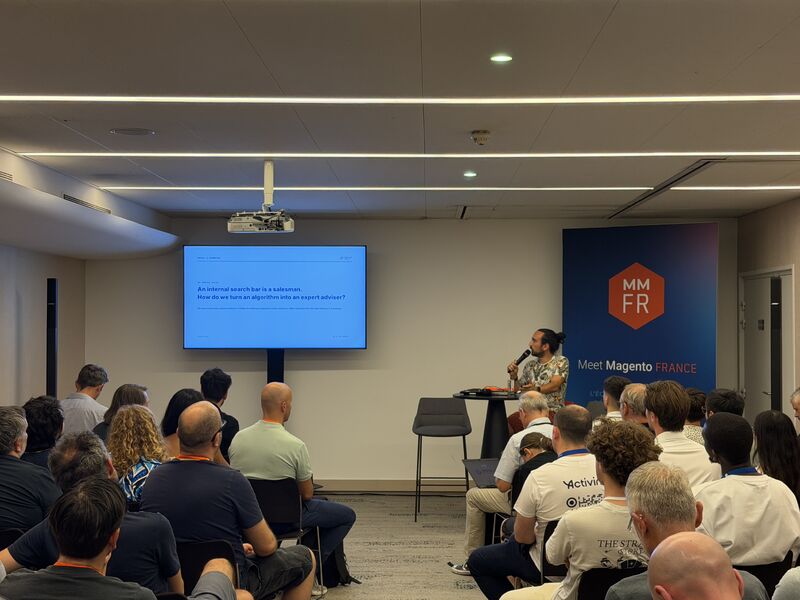
On June 25, 2026, the Adobe Commerce and Magento ecosystem gathered in Paris for the second edition of Meet Magento France 2026. The event has officially established itself as the premier hub for the French-speaking ecosystem, alternating between business strategy, merchant use cases, and technical deep-dives into web performance, AI, and product discovery.
Among the key highlights of the day, the technical keynote delivered by Romain Ruaud, Creator of ElasticSuite, captured the full attention of e-merchants and system integrators alike.
Table of Contents
Watch Romain Ruaud’s Full Keynote at Meet Magento France 2026
In this video, Romain illustrates with concrete examples how to transition from a keyword-centric engine to a conversational search experience driven by your merchandising teams.

2. From Lexical Matching to Intelligent Search
For a long time, search was strictly limited to keywords. A user typed a query, the engine searched for exact string matches in product titles or descriptions, and returned a list sorted by lexical relevance. This legacy model quickly hits a wall when faced with fuzzy queries (“back pain chair”, “Mother’s Day gift”, “winter running sneakers”) or conversational language.
Modern engines like ElasticSuite now combine several architectural layers: typo tolerance, semantic matching, synonym management, business rule boosting, and behavioral data exploitation. The goal is no longer to match words, but to interpret the real intent behind the query to propose the most relevant products for both the user and the merchant.
Generation 1: Lexical Search
Strict exact-match algorithms. Highly vulnerable to typos and pluralizations. Offers zero business control.
Generation 2: Intelligent & Semantic
Understands context and synonyms. Tolerate mistakes and maps broad queries to specific product attributes.
Generation 3: Searchandising
Fuses user intent with commercial rules (margins, stock, campaigns) and real-time behavioral data.
3. Searchandising: When Search Becomes Merchandising
Searchandising merges internal site search with visual merchandising, turning the engine into a commercial steering wheel. It allows you to stop relying on an opaque algorithm and start defining clear business rules: push high-margin products, clear dormant stock, highlight a partner brand, or adapt your catalog display to a seasonal marketing campaign.
During the talk, Romain demonstrated how a properly configured engine becomes a profit center: users who interact with the search bar typically convert 2 to 3 times higher and can generate up to 10-15% in additional revenue when searchandising is mastered. Ignoring this channel simply means leaving money on the table.
4. The Shift Toward Conversational Search
The most striking evolution in recent years is the transition from short keywords (“office chair”) to near-natural language formulations (“I’m looking for a cheap office chair for back pain”). Modern AI-based engines map these long queries to specific product attributes (usage, benefit, price, material, style) to deliver an intelligent response.
Romain illustrated this shift by showing how an engine handles symptomatic queries (“beds for small rooms”, “solutions for dry hair”) without depending on a strict word match in the product description. This is where searchandising becomes highly strategic: the engine does more than find items; it guides the user toward the exact right solution.
5. B2C vs B2B: Two Different Search Realities
The keynote also addressed the fundamental differences between B2C and B2B search behaviors.
| Ecosystem | Search Reality & Engine Requirements |
|---|---|
| B2C Commerce | Queries are often imprecise, emotional, and need-driven (“gift for a teen”, “boho wedding outfit”). This requires flawless management of synonyms, categories, and semantics. |
| B2B Commerce | Must handle specific product codes, technical SKUs, and deep catalogs. Precision and comprehensive filtering are vital. |
An engine like ElasticSuite successfully bridges both worlds, offering an architecture that can process both “human” conversational queries and highly structured technical searches.
6. The Role of Behavioral Data & ElasticSuite
A major thread throughout the talk was the rise of data as the true fuel for searchandising. Modern engines collect clicks, scrolls, add-to-carts, and conversions to learn exactly which results perform best. Romain demonstrated how merchants can dynamically optimize product hierarchies based on these signals, as well as contextual data (new vs. returning customer, device, marketing source).
This is precisely why ElasticSuite stands out in the Adobe Commerce ecosystem. As an open-source solution, it replaces the native engine to offer a highly semantic, typo-tolerant search experience. More importantly, it features a visual interface that translates complex commercial strategies (margins, seasonality, stock levels) into actionable daily workflows for merchandising teams. This perfect alignment between long-term search vision and operational autonomy is exactly what generated such enthusiasm during the Meet Magento France 2026 keynote.