Why Merchandising Is Becoming
a Competitive Advantage in E-commerce
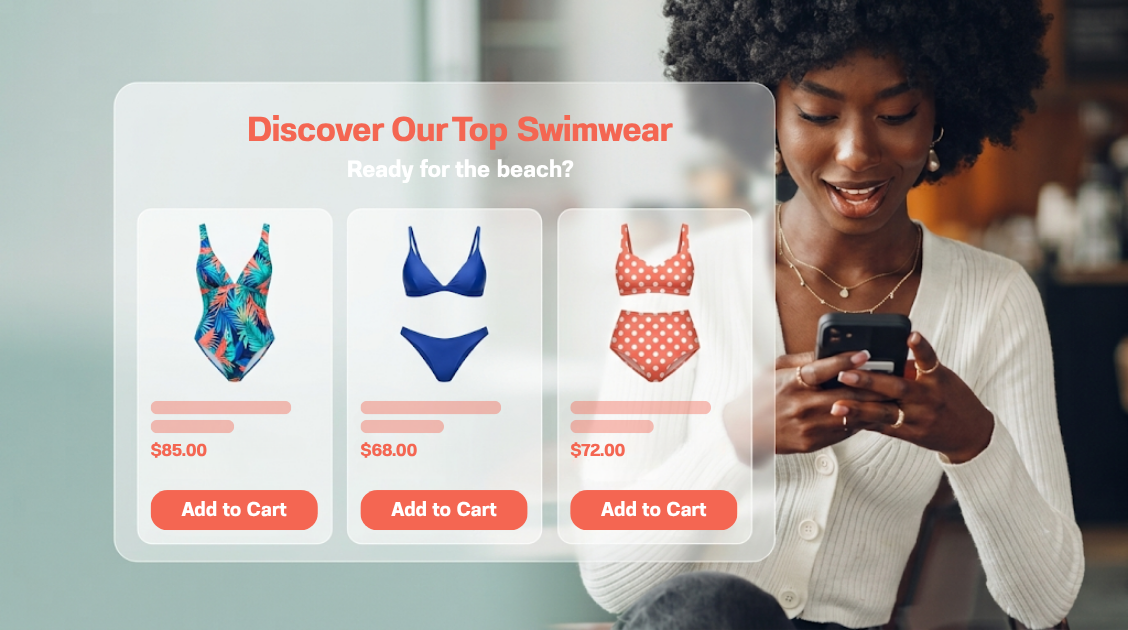
For years, the way to win in e-commerce was simple: buy more traffic. That game is over. Today, merchandising is becoming the real competitive advantage.
Everyone bids on the same keywords, in the same auctions, at ever-rising prices. Paid acquisition has become a commodity, a cost, not a moat. The real difference now happens after the click: in whether a shopper finds the right product in three seconds or gives up and leaves.
That’s merchandising. Long treated as a cosmetic, “make-the-page-look-nice” job, it has quietly become the single highest-leverage asset in online retail, because it’s the one thing that lifts conversion, average order value and retention at the same time, and it runs on data your competitors simply don’t have. This article explains why the shift is happening now, what the numbers say, and exactly where to start.
Table of Contents
1. What e-commerce merchandising actually is
E-commerce merchandising is everything that decides which products a shopper sees, in what order, and how they’re presented. In a physical store, that’s the window display and the shelf at eye level. Online, it’s the search bar, the results page, the recommendations, and the rules that push your best products forward.
In practice, it comes down to four levers working together:
| Lever | In plain terms |
|---|---|
| Search & discovery | Understanding what someone means, not just the words they typed, handling typos, synonyms and phrases like “red running shoes under $80.” |
| Ranking | Deciding the order products appear in, balancing what the shopper wants against your goals: margin, stock, seasonality. |
| Personalization | Adapting results and recommendations to each shopper’s behavior and history, so two people never see the exact same page. |
| Business rules | Boost & bury, dynamic categories and smart filters that keep the storefront aligned with your commercial strategy. |
2. Why it’s becoming a competitive advantage
Three things happened at once, and together they moved the battleground from acquisition to experience.
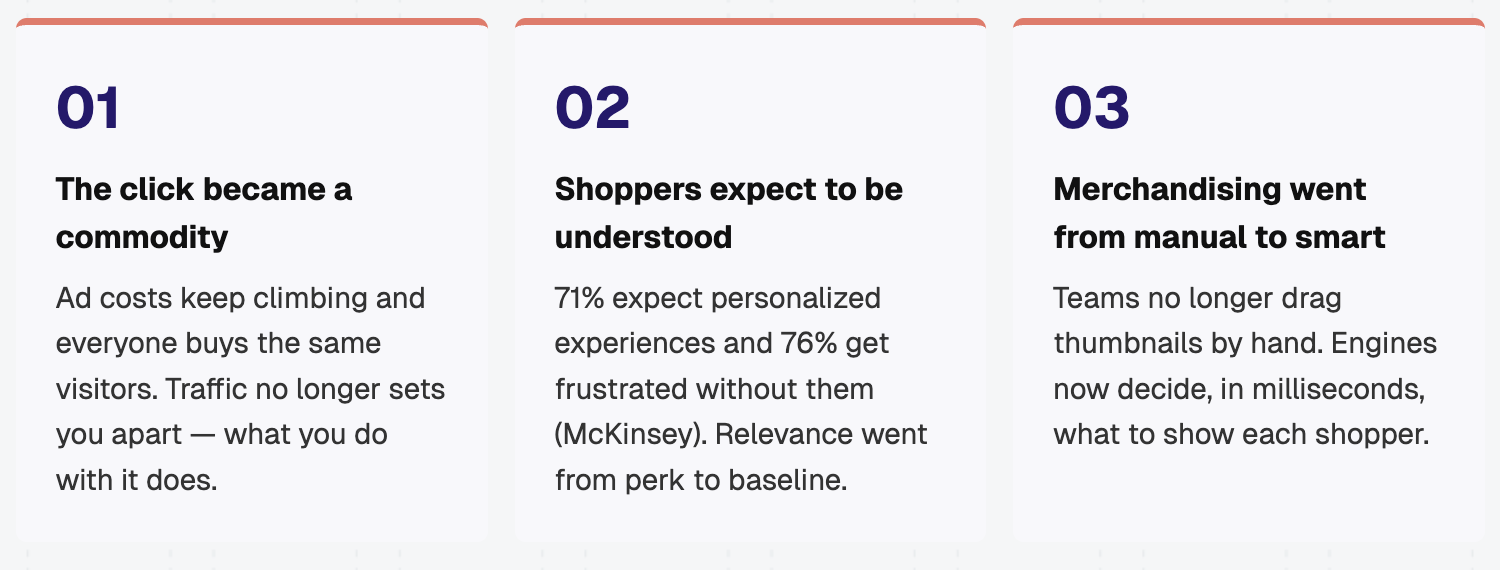
“Personalization is no longer a competitive advantage, it’s become table stakes. Retailers who fail to deliver it lose customers to those who understand them better.”
3. The proof, in numbers
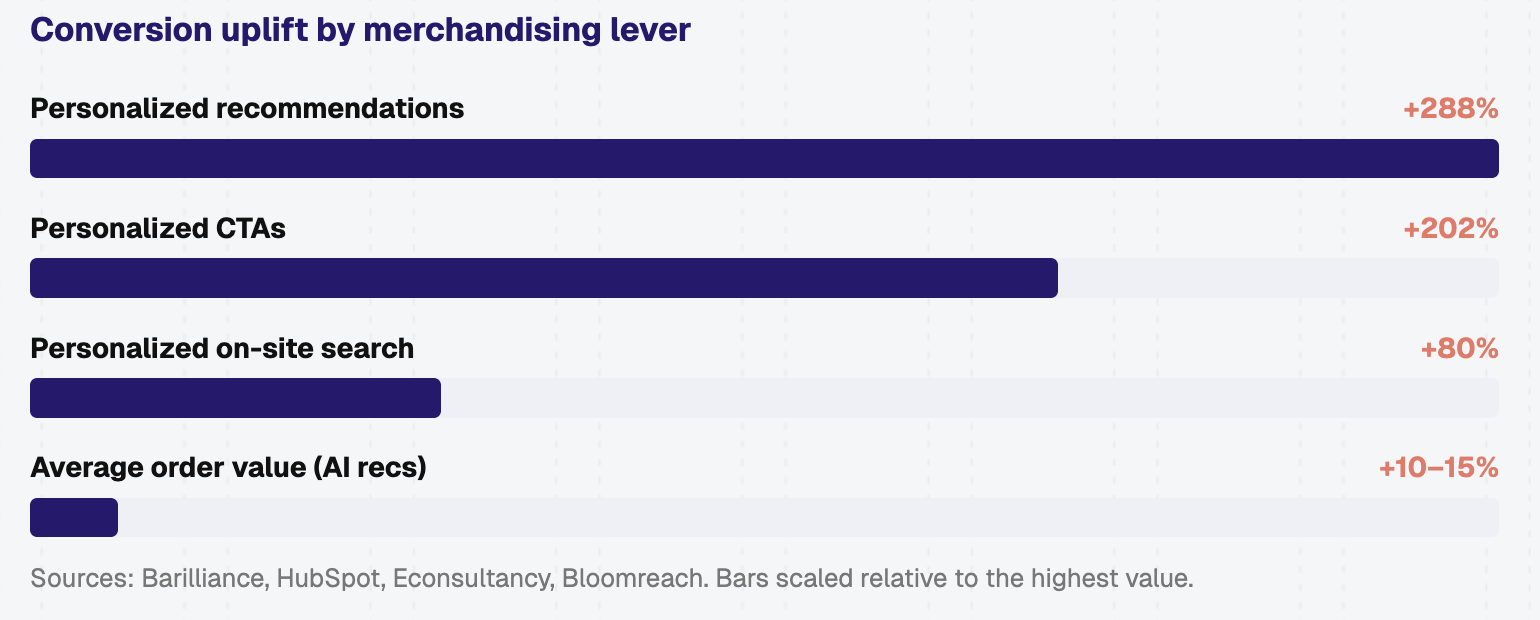
Most channels touch one part of the funnel. Merchandising touches three at once: conversion, basket size and loyalty. Here’s what good merchandising moves, according to the research.
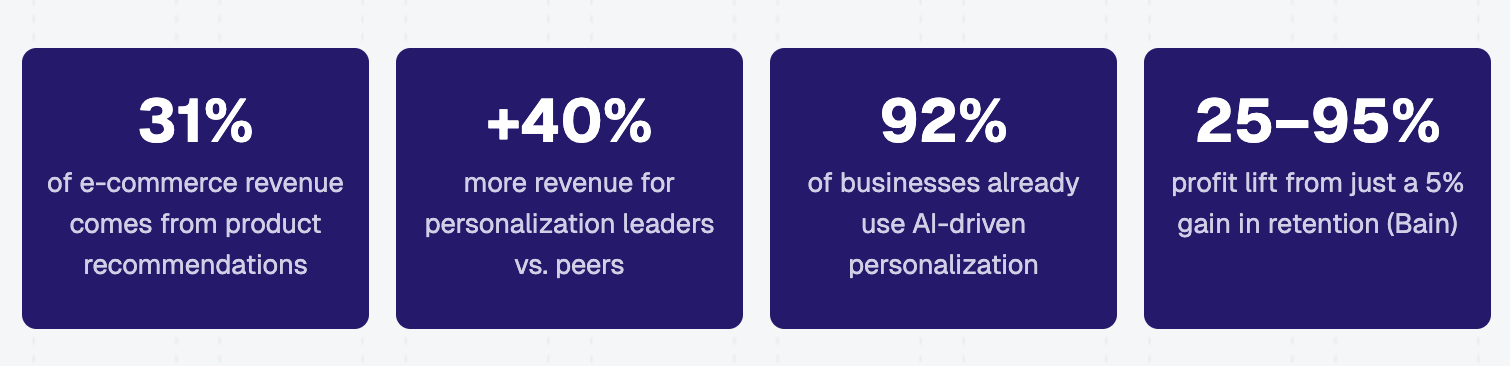
And the money is following: the market for e-commerce personalization software is projected to grow from $263M to $2.4B by 2033 (24.8% CAGR). Falling behind is getting more expensive every year.
4. On-site search: the hidden money channel
If you fix one thing first, fix on-site search. It’s where your highest-intent shoppers go, and it’s the most underfunded part of most storefronts.
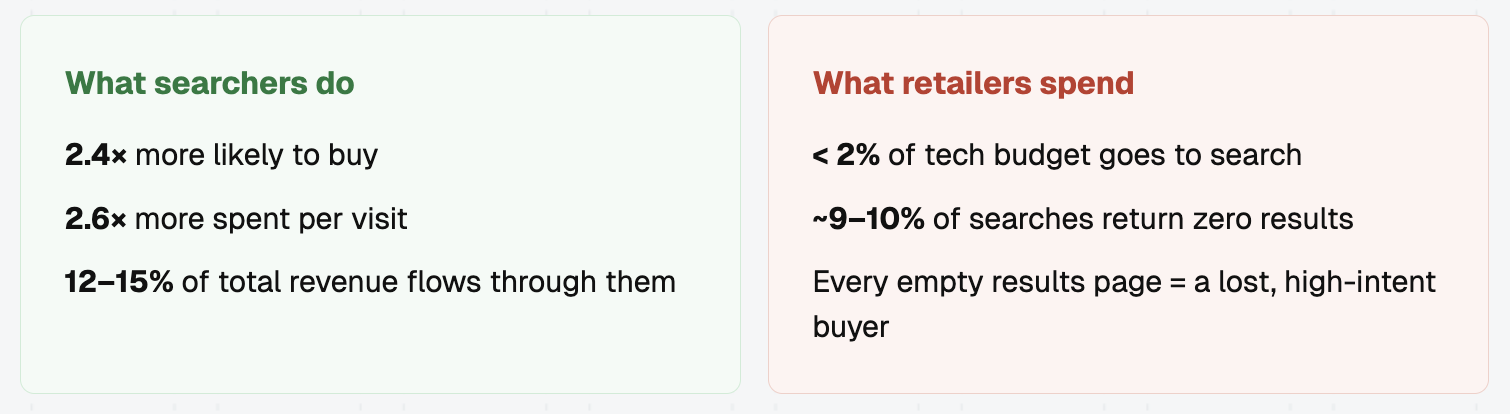
The imbalance is the opportunity. A single relevance upgrade can outperform six months of paid ads on revenue impact, because you’re recovering shoppers who already told you exactly what they want. (Want to measure yours? Start with our e-commerce search engine audit framework.)
5. Why the advantage compounds
A paid channel can be copied in one auction. Good merchandising can’t, because it rests on three things money alone can’t buy:
- • Your own data. The models learn from your shoppers’ clicks, searches and purchases, signal a competitor can’t replicate by outspending you.
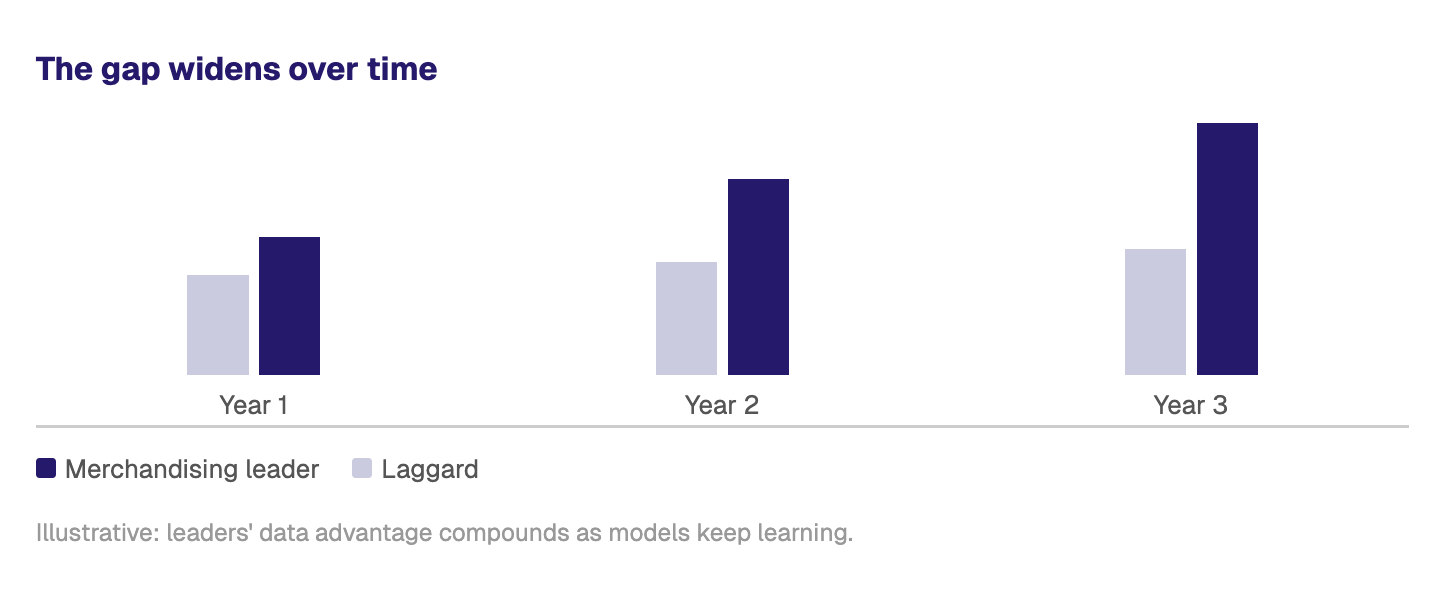
- • A compounding loop. The more the system runs, the sharper it gets. The revenue gap between leaders and laggards widens over time, not the other way around.
- • It’s wired into your strategy. Balancing relevance, margin and stock takes combined business and technical know-how, not an off-the-shelf plug-in.
6. Turning merchandising into an advantage: a 3-phase plan
Treat merchandising as a profit center, not a support function. Here’s a roadmap that pays back fast, then compounds.
Phase 1 – Quick wins (1–2 months)
Audit on-site search. Fix missing synonyms on your top 100 queries. Turn dead “zero-result” pages into discovery moments. Add boost & bury rules on top of relevance ranking so bestsellers and high-margin items stop getting buried.
Phase 2 – Foundations (3–6 months)
Clean your product data before touching algorithms, garbage in, garbage out hits harder here than anywhere. Add a semantic / AI vector search layer for conversational queries, and blend text relevance with behavioral ranking.
Phase 3 – Durable advantage (6–12 months)
Scale personalization and cross- & up-selling, with dynamic facets per category. Give someone ownership of continuous product-discovery optimization, and steer by the metrics that matter: zero-result rate, search-driven revenue share, personalization uplift.
Make merchandising your strategic asset
ElasticSuite sharpens search relevance, navigation and commercial performance – open-source, transparent and fully controllable. ESSENZA HOME lifted conversion by 30%; Chomette cut zero-results by 43%.
Get a demo →FAQ
Why is merchandising becoming a competitive advantage in e-commerce?
Because paid acquisition no longer differentiates, every competitor buys the same traffic at rising costs. Merchandising works after the click, where the retailer controls the experience, and it lifts conversion, average order value and retention together, powered by proprietary data that’s hard to copy.
What’s the difference between merchandising and e-merchandising?
Traditional merchandising works in physical stores, window displays and shelves. E-merchandising uses algorithms and real-time data to tailor what each shopper sees online, matching results and recommendations to their intent.
How much does merchandising affect revenue?
Personalized recommendations can lift conversion by up to 288% and drive 31% of e-commerce revenue. On-site search accounts for 12–15% of revenue and converts 2–3× better than browsing. Personalization leaders generate about 40% more revenue than peers.
Where should I start to improve my merchandising?
Start with an on-site search audit: find zero-result queries, fix synonyms on your top 100 searches, and add boost & bury rules on top of relevance ranking. These quick wins ship in 1–2 months, before you invest in an AI layer and personalization.