Why Ecommerce Platform
Migrations Fail | Shopware Meetup
In ecommerce, migration projects are usually described as technical programs. Teams discuss APIs, data models, integrations, storefront architecture, and deployment options. Those questions matter. But they are not always where a replatforming effort gets blocked.
In many cases, the first real obstacle appears much earlier. It appears when the business has to trust a new platform enough to move.
That is what made one part of the recent Shopware conversations in France particularly interesting. Beyond architecture and feature sets, a more practical question surfaced: what actually prevents merchants from adopting a new platform, even when the technical case is sound?
The answer is often not technical at all.

A migration can be rational on paper and difficult in practice
For agencies and merchants alike, replatforming often starts from a familiar situation. A legacy setup has been stretched over time. The business has added custom features, specific workflows, multiple integrations, and years of operational habits on top of it. What once felt sufficient gradually becomes fragile. The platform still runs, but every change becomes harder, slower, and more expensive to manage.
At that point, migration becomes a reasonable conclusion. But “reasonable” does not automatically mean “easy to approve.”
A new platform may offer stronger foundations, more flexibility, and a better long-term fit. That still leaves a difficult business question: why take the risk now? For merchant teams, the issue is not only whether the target platform is technically capable. It is whether the move feels credible, supportable, and safe.
This is where many migration conversations slow down. Not in the build phase, but in the confidence phase.
The replatforming blind spot: adoption starts before implementation
One of the most useful lessons from e-Frogg’s perspective is that technical fit and adoption are not the same thing.
Raphaël Homann described a situation many agencies will recognize. Some long-standing client setups had reached the point where their original foundations were no longer strong enough for what the business needed next. Shopware emerged as the right technical answer for these more demanding requirements. But convincing clients to move was a separate challenge.
That challenge was commercial and relational before it was technical.
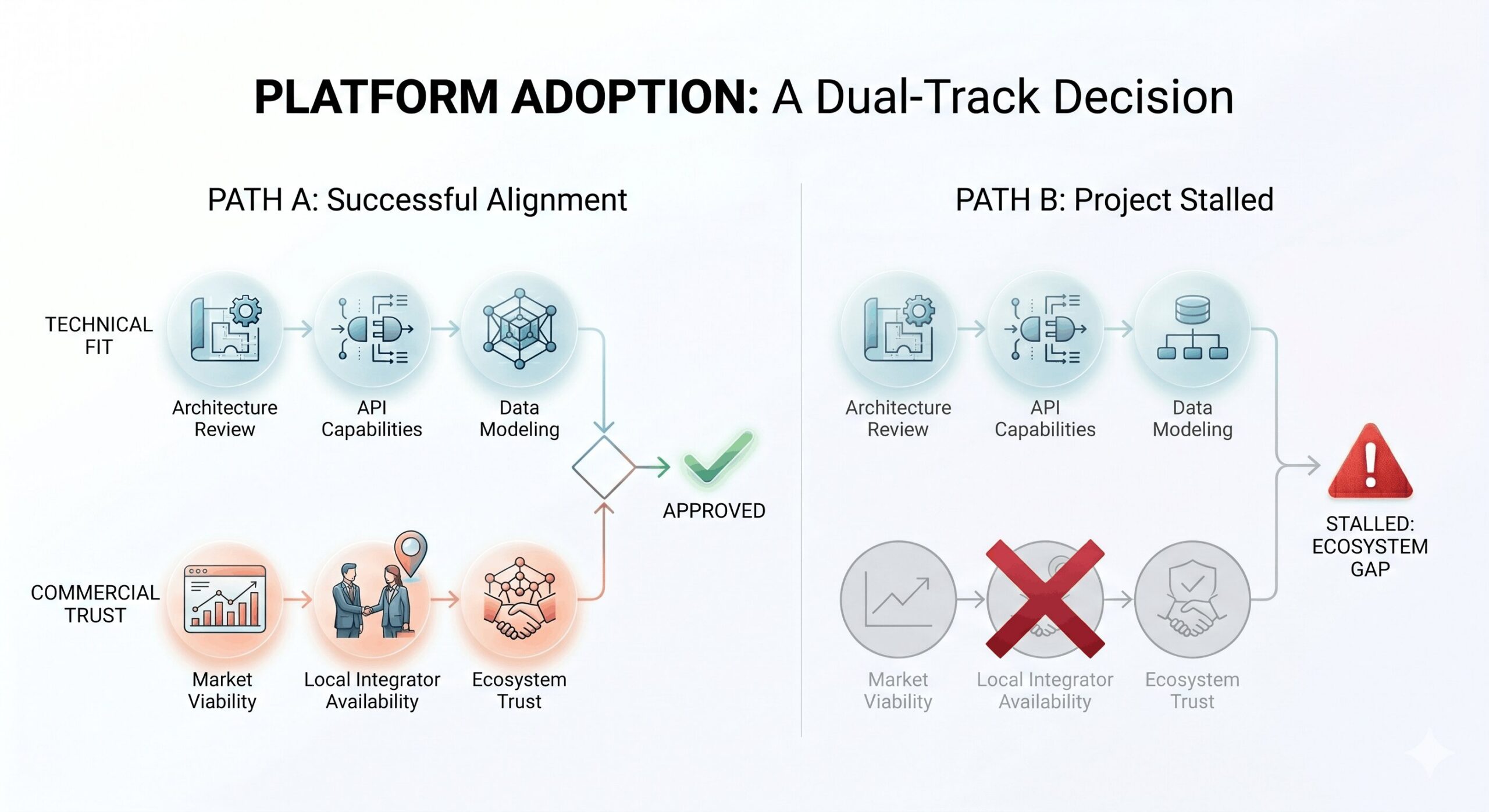
Clients do not evaluate a platform the same way an architect or technical lead does. They are not starting from API quality or extensibility. They are starting from questions of exposure and accountability:
- • Who is this platform in our market?
- • How established is it?
- • Who can support us locally?
- • If we make this move, are we stepping onto something solid or stepping into uncertainty?
These are not superficial concerns. They are the actual preconditions for buy-in. A migration can be technically sound and still stall because the business does not yet trust the surrounding ecosystem enough to proceed.
Technical Fit vs. Commercial Adoption
| Replatforming Phase | The Technical Requirement (Architecture) | The Adoption Requirement (Trust & Ecosystem) |
|---|---|---|
| Vendor Selection | API-first and composable architecture. | Demonstrated local presence and proven regional integrators. |
| Project Kickoff | Clear data mapping from legacy ERP. | Stakeholder alignment on long-term platform viability. |
| Implementation | Successful headless deployment. | Internal team confidence and merchant platform adoption. |
Why local presence matters more than many platform teams admit
This is where a local ecosystem becomes more than a nice-to-have. Platforms often talk about entering a market in terms of opportunity, product fit, or commercial expansion. But for merchants and agencies, a local presence changes something much more concrete: perceived risk.
When a platform has visible local activity, partners, events, reference points, and support structures, the migration conversation changes. The platform no longer feels like an abstract option from another market. It starts to feel legible. It becomes easier for an agency to recommend and easier for a merchant to justify internally.
That was one of the deeper signals behind Shopware’s recent activity in France. The significance was not simply that the brand showed up. It was that the platform became easier to place in a real local business context.
Rob Zuiderhoek’s positioning of Shopware in France reinforced this point from another angle. Shopware is not trying to compete on extreme simplicity. Its proposition is stronger in complex commerce: B2B, hybrid models, larger catalogs, multiple systems, and more flexible architectures.
That kind of proposition can be attractive, but it also raises the stakes. The more structural the platform decision, the more reassurance the market needs around it. Complex commerce is rarely sold on features alone. It is sold on trust.
A strong technical fit still needs a believable ecosystem
This is why the same platform can look very different depending on the market around it.
In one context, it is a credible next step. In another, it feels like an unproven risk. The architecture may be identical. The difference lies in what surrounds it: implementation capacity, visible partners, known references, language proximity, and signs of long-term commitment.
Seen this way, community-building is not peripheral to platform adoption. It is part of the adoption mechanism itself.
“For a merchant evaluating replatforming options, the platform is never the only thing being chosen. They are also choosing the ecosystem that will have to support that platform over time.”
This helps explain why early community moments matter. Not because they are symbolic, but because they reduce ambiguity.
What this means for agencies and merchants
- • For agencies and integrators: Choosing the right platform is not enough. The recommendation has to be supported by a wider narrative the client can believe in. That includes ecosystem credibility, partner confidence, and a sense that the platform is present in the client’s market in a meaningful way.
- • For merchants: Migration decisions should not be evaluated only through feature comparisons or infrastructure diagrams. They must also be evaluated through the strength of the local support environment. A strong platform backed by a visible ecosystem can lower risk from the very beginning.
This is one reason the current Shopware dynamic in France matters. It suggests that some of the friction traditionally associated with adopting a less established platform may begin to ease when the ecosystem becomes more tangible.
Migration begins with confidence
The common language of replatforming still tends to overemphasize implementation and underemphasize adoption. But many projects are shaped before implementation begins.
They are shaped in sales conversations. In client hesitation. In internal alignment meetings. In the ability of an agency to say not only “this platform is technically right,” but also “this platform is real, supported, and credible in your market.”
That is the part of migration that often decides everything else. A platform migration may eventually succeed or fail in code. But it usually starts succeeding or failing much earlier—in the level of confidence the business has in the move itself.
FAQ
Why do ecommerce platform migrations often stall early?
Because the first barrier is often trust, not implementation. Before technical work begins, businesses need confidence in the platform, the partner, and the local ecosystem around the project.
Why does local market presence matter in replatforming?
It reduces perceived risk. A visible local ecosystem gives merchants more reassurance around support, references, accountability, and long-term viability.
What makes Shopware relevant in this context?
Shopware is positioned for complex commerce use cases such as B2B, hybrid models, large catalogs, and composable environments. As its local presence grows, it becomes easier for agencies and merchants to adopt with confidence.
What is the main lesson from e-Frogg’s perspective?
That a migration can be technically well justified and still remain difficult to sell internally if the client is not yet comfortable with the platform choice.