
Searchandising is the practice of turning on-site search into a merchandising surface. It combines search relevance with merchandising control so every query can surface the products that matter to both shoppers and the business. In plain terms: search × merchandising, working as one system instead of two disconnected ones.
This guide explains what searchandising is, why separating search from merchandising creates friction, how it works under the hood, how to think about cost, and how to tell whether your store has a searchandising problem.
Table of Contents
1. Searchandising, defined
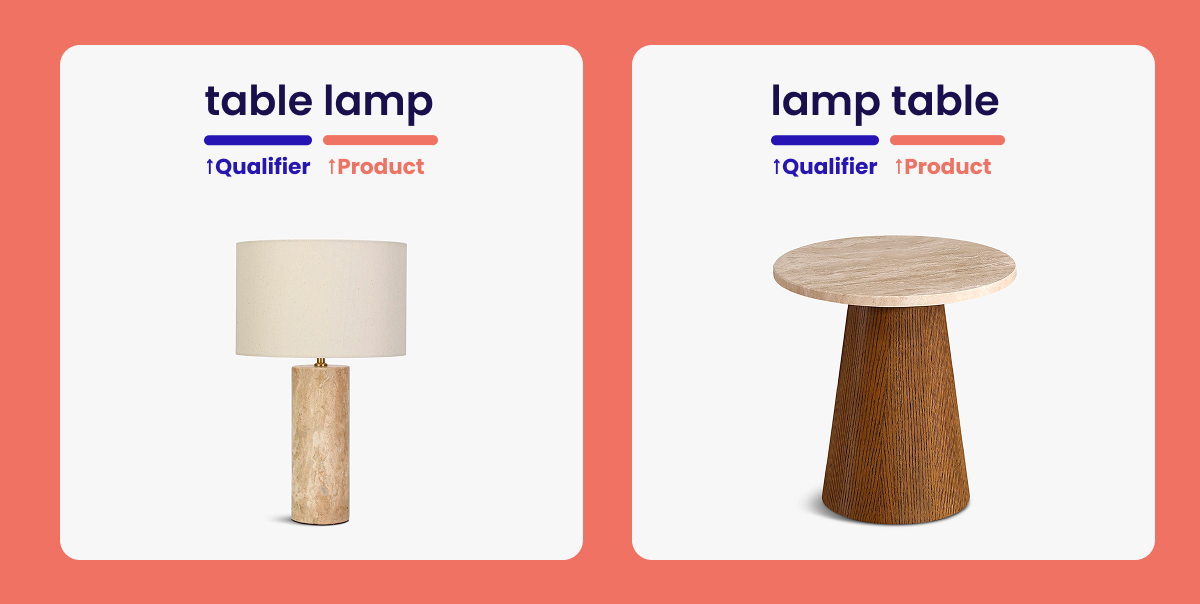
Searchandising blends two words because it blends two jobs most stores keep apart. Site search answers one question: “Which products match this query?” It optimizes for textual relevance. Merchandising answers a different one: “Which products should we promote right now?” It optimizes for margin, stock, seasonality, and strategy.
Searchandising brings those two jobs together. Your search merchandising logic runs inside the search engine itself, so when a shopper types a query, the results reflect relevance and commercial priorities at the same time. A bestseller ranks first not by accident, but because someone decided it should. Search becomes a product discovery engine the business can steer, rather than a black box that ranks products by rules nobody can see.
2. Why search and merchandising shouldn’t live in separate silos
On most stores, ownership is split. Search belongs to developers and is treated as infrastructure. Merchandising belongs to marketing and category managers and is treated as a manual task, usually limited to catalog pages.
The problem is that on-site search is often the highest-intent surface on a store. Searchers often convert at a higher rate than browsers, because a shopper using search is telling you what they want to buy. Yet it is frequently the one surface nobody fully owns, so it defaults to generic ecommerce search behaviour and ignores what the merchandising team knows.
The result is familiar: out-of-stock items ranking on page one, new collections buried, high-margin products hard to find, and zero-result search pages that can send a ready-to-buy customer to a competitor.
3. How searchandising works
Under the hood, searchandising typically runs in two stages: retrieval and ranking. Retrieval decides which products are eligible for a query. It parses attributes such as brand, colour, cut, or type, interprets intent, and expands the query with synonyms and typo tolerance, so “skii jackett” can still find the ski jacket. Ranking then decides the order of those eligible products.
A capable engine scores each product on several signals, which may include:
- • Relevance: how well the product matches the query.
- • Product performance: click-through, add-to-cart and conversion rates for that query.
- • Behavioural signals: what shoppers view, click and buy over time.
- • Availability and freshness: in-stock status, new arrivals, seasonal recency.
- • Business rules: the boosts, buries and margin priorities you define.
The difference between plain search and searchandising is that last layer. In searchandising, the merchandising team can control how these signals are weighted, rather than accepting whatever the algorithm defaults to.
4. Filters vs facets
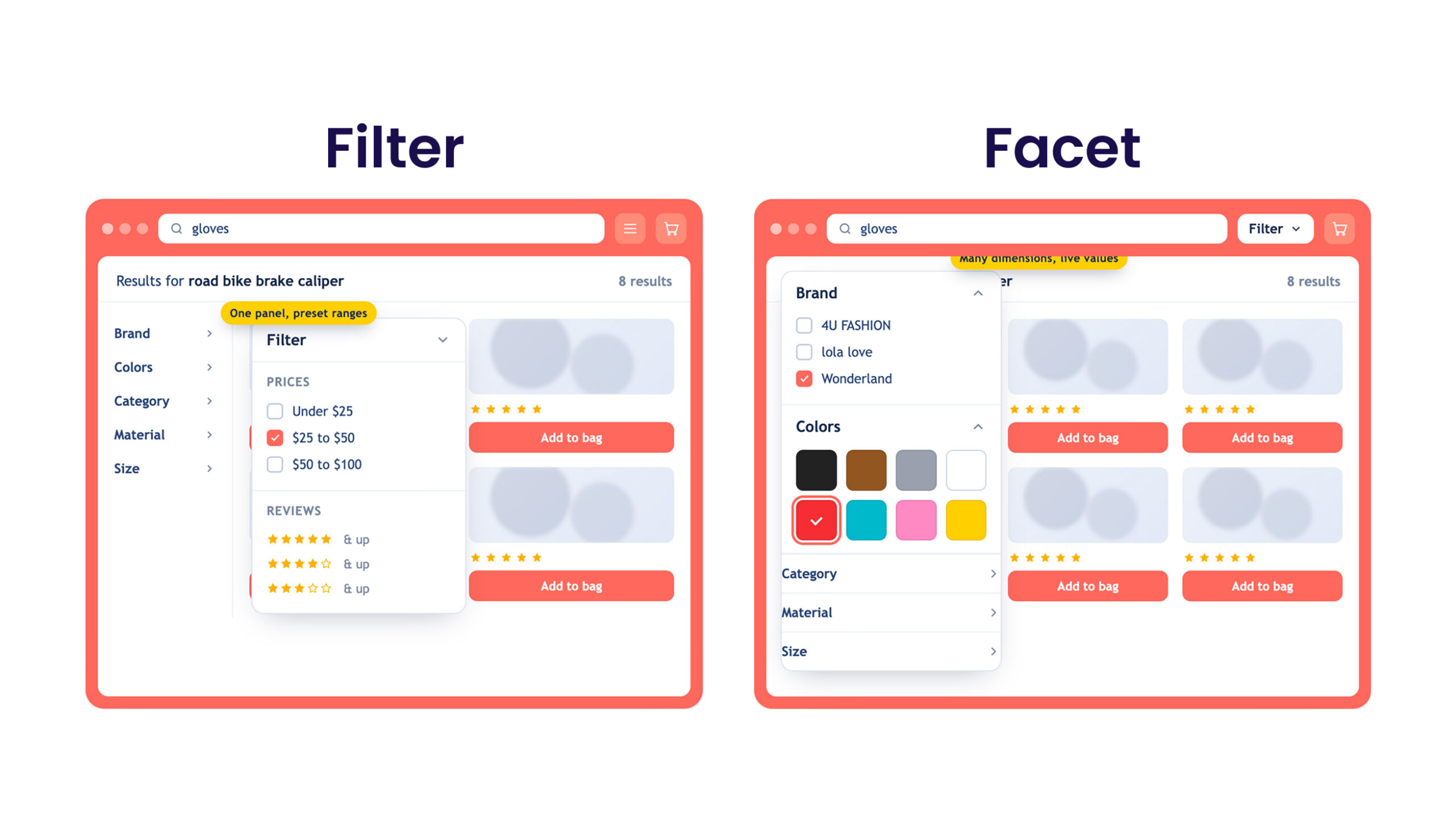
Both narrow results, but they behave differently, and getting the distinction right is core to good searchandising. Filters are broad, fixed criteria that do not change between searches, like price range or rating. Facets are specific to the results of a given query, drawn from the attributes of the products actually returned, like brand, colour, or model year. A good engine surfaces the most useful facets first instead of dumping a long unordered list on the shopper.
5. The 4 principles of good searchandising
The team can decide what ranks: boost bestsellers, new arrivals, and high-margin products; bury out-of-stock and slow movers. Strategy drives the results, not only the algorithm.
You can see why a product ranks where it does, so ranking decisions are readable and adjustable rather than a guess.
Better relevance tends to mean fewer dead ends and more conversion. Analysts and vendors commonly report revenue-per-visitor gains in the range of 5 to 10 percent from improving search merchandising, though results vary by catalog and starting point.
Depending on the platform, an open-source foundation can mean more control over your business logic and less exposure to vendor lock-in.
6. How to think about cost
Pricing models differ, and the difference matters more than many buyers expect. Some proprietary platforms price by search request or API call, with entry packages that can start in the tens of thousands per year and scale with catalog size and query volume. The trade-off is that cost can rise alongside traffic, so a strong sales period can also mean a larger bill.
Other approaches, including open-source-based solutions, aim for more predictable pricing that is not tied to every query, in exchange for a different operating model. Neither model is universally “better”; the right one depends on your catalog size, traffic pattern, in-house resources, and appetite for lock-in. The useful questions to ask a vendor:
- • Does cost scale with query volume?
- • Who owns the data and the business logic?
- • How hard is it to leave?
7. What it moves in real stores
Done well, the impact is measurable. A few examples from merchants running ElasticSuite:
|
+33%
transactions
MegaDental
|
−43%
zero-result searches
Chomette
|
+5%
search revenue
Cultura
|
The common thread is not a bigger AI budget. It is giving the merchandising team more control over discovery.
See searchandising on your own catalog
ElasticSuite brings search, merchandising, and personalization into one platform. It is native to Magento and Adobe Commerce, and through Gally it extends to Sylius, Shopware, OroCommerce, and composable commerce architectures.
Get a demoFAQ
What is searchandising?
Searchandising is using your on-site search engine as a merchandising surface: combining relevance with merchandising control so results reflect both what the shopper wants and what the business wants to promote.
What is the difference between search and searchandising?
Plain search answers “which products match this query?” Searchandising adds a control layer on top: the merchandising team decides how relevance, behaviour, stock and business rules are weighted, so the right products rank first.
What’s the difference between filters and facets?
Filters are broad, fixed criteria that do not change between searches (price, rating). Facets are specific to the results of a given query, drawn from the attributes of the products actually returned (brand, colour, size).
How do I know if my store has a searchandising problem?
Common signs: “0 results” on typos or synonyms, out-of-stock products ranking first, a merchandising team that can’t change rankings without a developer ticket, no visibility into which searches fail, or search costs rising faster than search revenue.
Does ElasticSuite work on platforms other than Magento?
Yes. ElasticSuite is native to Adobe Commerce and Magento. For other stacks such as Sylius, Shopware, OroCommerce, and composable architectures, Gally provides the same searchandising capabilities as a standalone, API-first engine.